
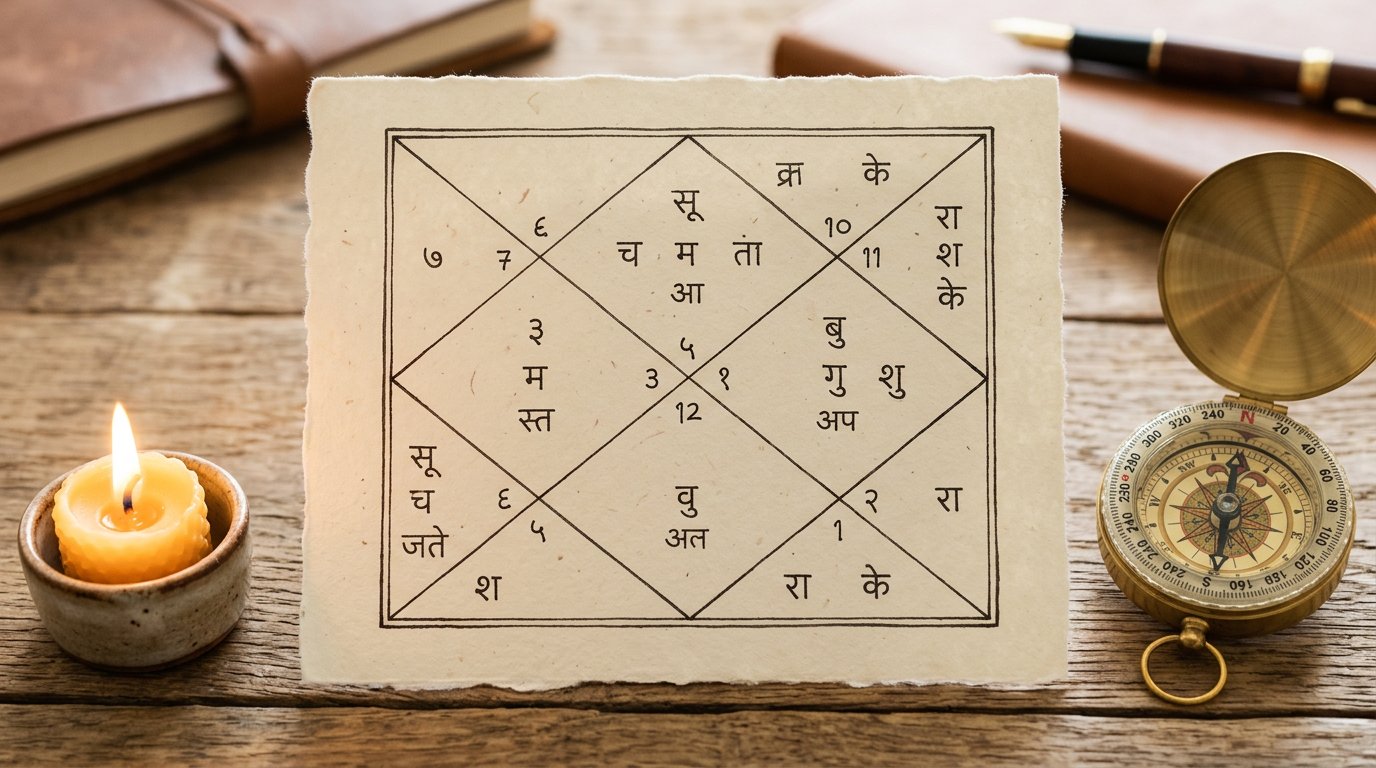
Vedic Astrology for Beginners: Understand Your Kundali in 10 Simple Steps
If you've ever opened a kundali and felt like you were looking at a math puzzle in a language you don't speak, you're not alone. Most people do. And that's because most people are handed a chart without being told what they're actually looking at.
Let me fix that.
Vedic astrology for beginners isn't about memorizing every planet and dasha. It's about learning the skeleton of the chart. Once you know the skeleton, you can hang the details on it — and you'll finally stop feeling lost.
Here are the 10 steps I'd walk anyone through, the first time they look at their own kundali.
Step 1 — Get your birth details right
This sounds boring, but it's the most important step.
You need:
- Exact date of birth
- Exact time of birth (note: not "around 10 AM")
- Place of birth (for longitude and latitude)
A 5-minute mistake in birth time can change your ascendant. And the ascendant is the "you" of the chart. So before anything else, confirm your birth time from a birth certificate, hospital record, or an older family member.
Step 2 — Find your Lagna (Ascendant)
The lagna is the sign rising in the east at your birth. It's written on the top-left of most kundalis, and it's the "first house" of your chart.
Your lagna is your physical self, your body, your approach to life, and how the world sees you.
So if your lagna is Aries, you get a certain set of themes (energy, drive, head-related things). If it's Pisces, the themes shift (sensitivity, imagination, feet-related things). This is the base of the whole reading.
Step 3 — Locate the Moon sign
The Moon sign is where the Moon was sitting at birth. It changes fast — roughly every 2.5 days — so this is where exact birth time really matters.
Indian culture often uses the Moon sign (rashi) for daily horoscopes, gemstone recommendations, and muhurta. Think of the Moon sign as your inner emotional world. Your lagna is your outer shell.
Step 4 — Spot the 12 houses
Every kundali has 12 houses. Each house covers a life area. Here's the simple map:
- Self, body, personality
- Money, family, speech
- Courage, siblings, communication
- Home, mother, peace of mind
- Creativity, children, intelligence
- Obstacles, health, competition
- Marriage and partnership
- Transformation, longevity, hidden things
- Fortune, father, higher learning
- Career, reputation, status
- Gains, friendships, income
- Losses, foreign places, sleep
Once you know what the house represents, you know where a planet is working.
Step 5 — Understand the 9 planets
Vedic astrology uses nine grahas:
- Sun, Moon, Mars, Mercury, Jupiter, Venus, Saturn, Rahu, and Ketu
Each has its own nature:
- Sun — authority, soul, father
- Moon — mind, emotions, mother
- Mars — courage, action, brother
- Mercury — intellect, speech, business
- Jupiter — wisdom, luck, teacher
- Venus — love, relationships, comfort
- Saturn — discipline, delay, karma
- Rahu — obsession, foreign things, unconventional paths
- Ketu — detachment, spirituality, past karmas
A planet doesn't just mean something by itself. It means something based on the house it sits in.
Step 6 — Match planets to houses
This is where the chart comes alive.
If Mars is in your 7th house, it changes how you handle marriage. If Jupiter is in your 10th house, it supports career growth. If Saturn is in your 2nd house, money may come with delays.
You don't need to know every combination. Just ask: which house is this planet sitting in, and what does that house mean?
Step 7 — Check the Dasha system
Dashas are planetary time periods. They tell you when a theme is active.
The most common is Vimshottari Dasha. Each planet gets a fixed number of years, and they run in sequence. So if you're in a Saturn dasha, Saturn's lessons become louder. If you're in a Jupiter dasha, opportunities around wisdom, teaching, luck, and growth tend to expand.
Many people get confused here because they think a "bad" dasha means doom. It doesn't. It means Saturn is teaching you discipline. That can look like delay, but it often builds strength.
Step 8 — Look at the Moon's position in detail
The Moon is the most personal planet in a kundali.
Check:
- Which sign is the Moon in?
- Which house is the Moon in?
- Is the Moon bright (Shukla Paksha) or dark (Krishna Paksha)?
A strong, bright Moon in a good house tends to bring a calm, steady mind. A weak Moon can bring emotional swings. This alone gives people a massive insight into why they feel things so strongly.
Step 9 — Note the Yoga (combinations)
A yoga is a special combination of planets. Some famous ones are:
- Gajakesari Yoga — Jupiter and Moon connected, brings wisdom, respect, and good reputation
- Budhaditya Yoga — Sun and Mercury together, supports intelligence and communication
- Raja Yoga — connection between the 1st house lord and the 9th or 10th house lord, often linked to prosperity
People love asking about yoga because they sound exciting. But a yoga is only meaningful when you see the full chart. A good yoga in a weak chart can still struggle.
Step 10 — See the whole picture, not one planet
This is the step most beginners skip.
A single planet doesn't decide your whole life. If Saturn is "bad" in one house but Jupiter is strong in another, the chart isn't a disaster. You have to balance all the strength against all the weakness.
I always tell people: treat the kundali like a weather report, not a life sentence. It shows patterns and tendencies. It doesn't decide what you do with them.
My honest advice for a beginner
Start with your lagna and Moon sign. That's enough to understand 70% of your basic nature.
Then read one or two books by serious classical authors. And if you want a deeper reading, work with someone who takes the time to explain the why, not just the "you'll be successful after 2027."
The best kundali reading I've ever given wasn't the one with the most complicated math. It was one where I told a young man, "Your Jupiter is in the 10th house, but it's in a weak sign. So work on consistency now. The opportunity will come, but only if you're ready."
He didn't need to know every planetary degree. He needed a clear, usable next step.
FAQ
What is the first thing I should look at in my kundali?
Start with your lagna (ascendant) and Moon sign. They tell you the most about your personality and emotional nature.
Why is the exact birth time so important?
The ascendant changes roughly every 2 hours. A small error can change your lagna, houses, and Moon placement.
Do I need to know all 12 houses to read a kundali?
No. Learn the meaning of each house first, then map the planets into them. That covers most of the basics.
What is a good strength in a kundali?
A strong Jupiter, a well-placed Moon, and a beneficial connection to the lagna lord are generally considered good. But strength is always judged with the full chart.
Can one kundali predict my whole life?
No chart predicts everything. It shows themes, timing, and tendencies. Your effort and choices still shape the outcome.
Want a simple, honest reading of your own kundali? Send your date, time, and place of birth. The Bhavishyam team will walk you through it in plain language — no confusion, no unnecessary fear.
Continue reading: Lagna (Ascendant) Explained: How to Read the Sign That Defines You
Continue reading: Maha Dasha: How Planetary Periods Shape Your Life