
Vedic Astrology vs Western Astrology: Which One Should You Trust?
People ask me this almost every week. They see one video saying Vedic is the real deal, and another saying Western is all they need. So which one should you actually trust?
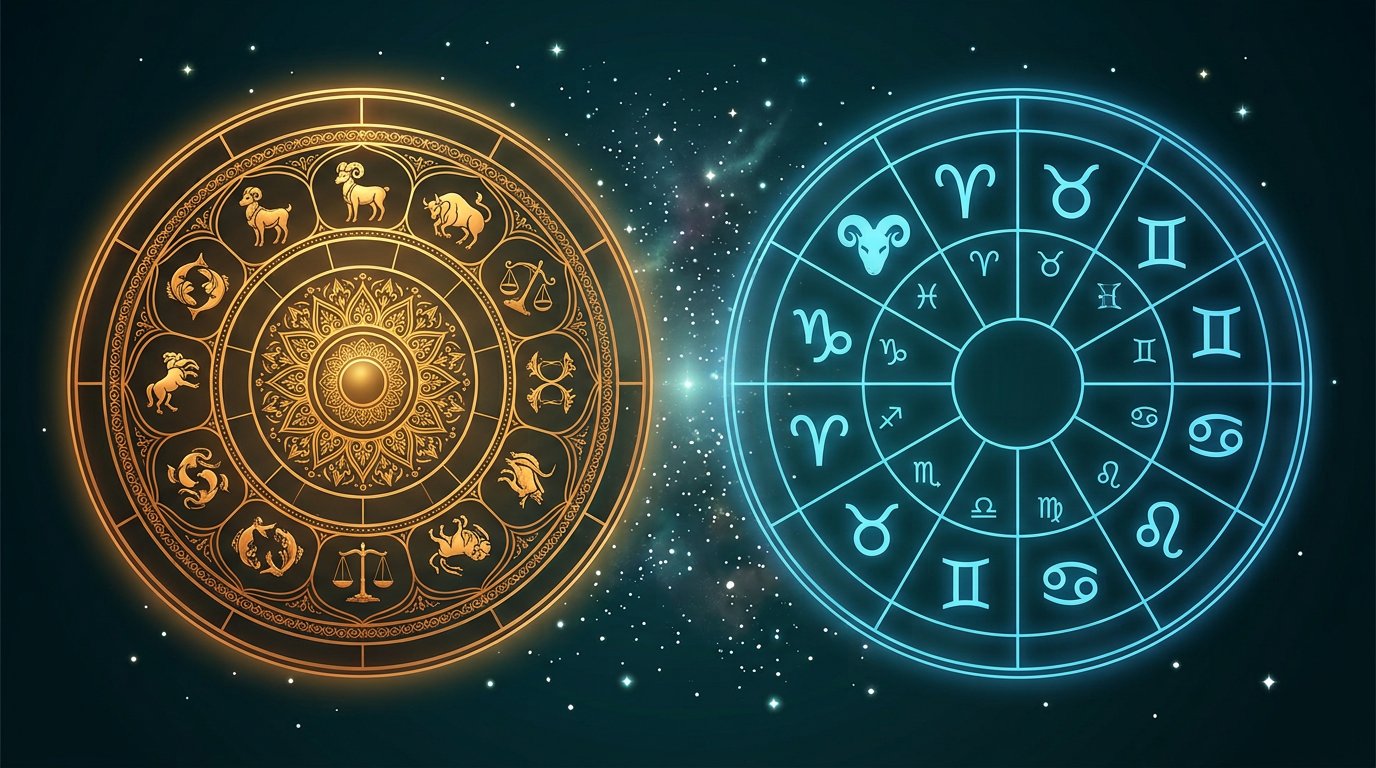
Short answer: both are real systems, but they answer different questions. Vedic astrology (or Jyotish) works from the sidereal zodiac — the actual position of the constellations. Western astrology works from the tropical zodiac — the position of the Sun relative to the seasons. That one difference changes your Sun sign, your houses, and even your ascendant if you were born close to a sign boundary.
Let me break it down the way I'd explain it to a friend over chai, not the way a textbook would.
First, understand the zodiac problem
The easiest way to see the difference is your own Sun sign.
If you were born on the 21st of any month, you've probably felt confused about whether you're really a Leo or a Virgo. That confusion is real, and it often comes down to the zodiac system someone used.
- Western astrology uses the tropical zodiac. It places Aries at the March equinox. The signs line up with the seasons.
- Vedic astrology uses the sidereal zodiac. It places signs where the constellations actually are in the sky right now.
- Because of a slow shift called the ayanamsa, the two systems are usually about 24 degrees apart today.
So a person born around 20–22 of a month can easily be one sign in Western and the previous sign in Vedic. This isn't an error. It's two different starting points.
The real difference: what each system is good at
I've done readings for people who loved Western astrology and people who only wanted Vedic. What I've noticed is nobody benefits from forcing one system to do everything.
Where Western astrology shines
- Psychological growth and personality work
- Understanding your emotional patterns
- Moon and Venus themes, relationships, inner needs
- Transits for short-term mental and emotional shifts
It's brilliant for self-awareness. If you want to understand why you react the way you do, Western gives you a beautiful, layered map.
Where Vedic astrology shines
- Timing events (career changes, marriage, relocation)
- Dashas (planetary periods) and long-life patterns
- Karmic themes, family issues, health patterns
- Remedial actions — mantras, gems, rituals, charity
Vedic is more practical and event-driven. That's why so many people in India use it before marriage, before starting a business, or before a big move.
What does "more accurate" really mean?
Here's the thing. When people say one astrology is "more accurate," they usually mean it predicted something they cared about. That's not really a fair test.
A prediction isn't more accurate just because it sounds stronger. Western astrology may say "you're a Scorpio with a Capricorn Moon." That's helpful. Vedic may say "your Jupiter dasha starts next March, so career questions become clearer." That's practical.
I've seen both systems give right answers. I've also seen both give wrong ones when the reader attaches too much certainty to a single chart. Any system can be misused.
Should you use both?
Honestly? I think a thoughtful reader should look at both. Not to confuse you, but to give you two different lenses.
Here's a simple way I recommend it:
- Use Western to know your personality, emotional tendencies, and life themes.
- Use Vedic for timing, remedies, and major life decisions.
- Never use either to make a medical, legal, or financial decision alone.
- Always cross-check with the actual story of your life, not just the chart.
In my experience, the best readings happen when both systems agree on a theme. If Jupiter is strong in both, and you're in a Jupiter dasha, a career upgrade makes sense. If they disagree, slow down and look at the chart more deeply.
Real example from my practice
One client, a sales head in Mumbai, kept struggling with job switches. Western told him he was in a tough Saturn period and should stay put. Vedic told him his Saturn dasha was ending and Jupiter was moving into his 10th house.
He waited eight months, as the Vedic chart suggested. Three months after that, he got a role with a 40% raise. Both systems were trying to say the same thing — just at different speeds. The problem wasn't the system. It was that he was reading one layer and missing the other.
What to do with this information
Don't panic about which zodiac you're on. Know your birth time accurately first. If you're born on a sign boundary, that 24-degree shift absolutely matters.
Then decide what question you're asking. If it's "why do I feel stuck?" — Western can help. If it's "when should I change jobs?" — Vedic can help.
And if someone tells you one system is "fake" and the other is "scientific," walk away. Real readers don't need to insult another tradition to look good.
FAQ
Is Vedic astrology more accurate than Western?
For timing events and practical life decisions, most Indian practitioners use Vedic. For personality and psychology, Western is very strong. "More accurate" depends on the question you're asking.
Why is my Sun sign different in Vedic and Western?
Because Vedic uses the sidereal zodiac and Western uses the tropical zodiac. They currently sit about 24 degrees apart.
Which astrology is best for career prediction?
Vedic astrology is usually better for career timing because it uses dashas, transits, and the 10th house in a more event-focused way.
Can I trust a Western reading if I'm Indian?
Yes. Western is excellent for self-understanding. Many readers combine both, and that's usually the most useful approach.
Do I need my exact birth time for both?
Yes. Exact birth time matters for the ascendant, houses, and moon placement. Without it, any reading is only a partial story.
Need a clear reading of your own chart? Share your full birth details (date, time, city) and let the Bhavishyam team look at your kundali with focused attention. We’ll help you pick the right system for the question you're asking.
Continue reading: Vedic Astrology for Beginners: Understand Your Kundali in 10 Simple Steps
Continue reading: Career Predictions from Your Birth Chart: Houses, Planets, and Remedies